Synthesis and characterization of the novel 80S bioactive glass: bioactivity, biocompatibility, cytotoxicity
DOI:
https://doi.org/10.29252/jcc.2.3.1Keywords:
Bioactive glass, 80S, Ca/P ratio, HydroxyapatiteAbstract
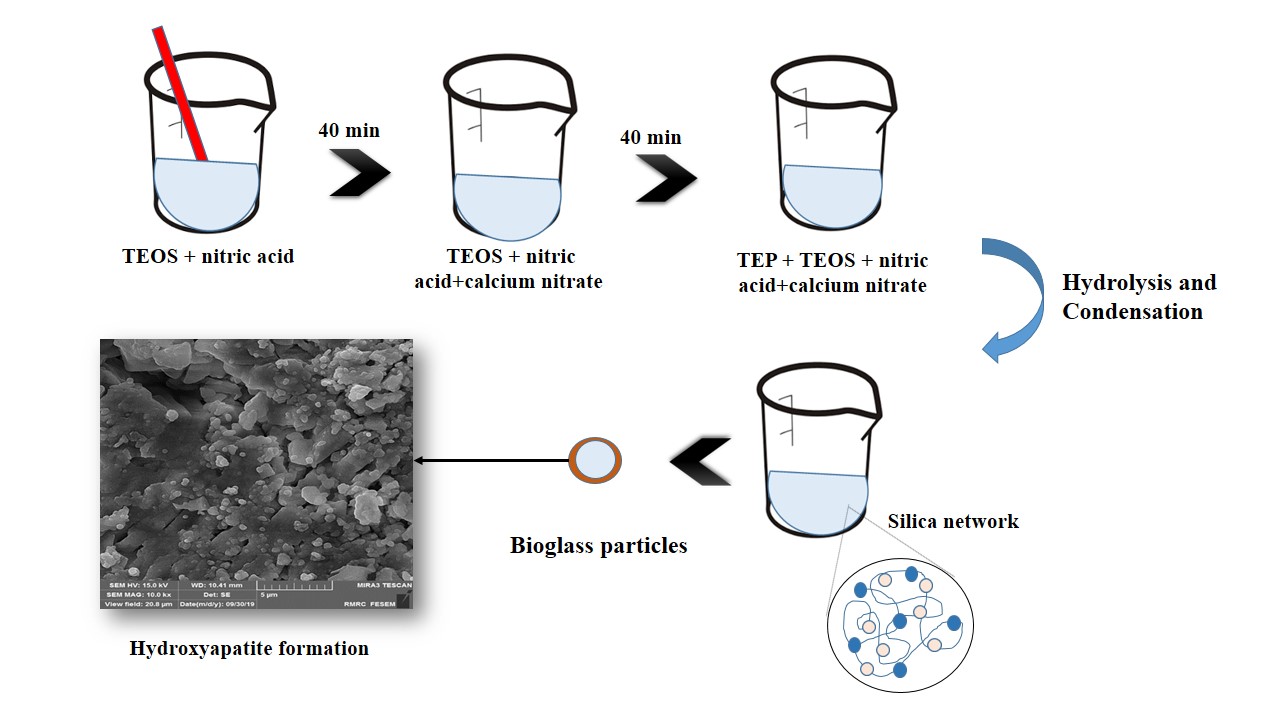
In this research, the 80S bioactive glass with different Ca/P ratios was prepared by the sol-gel route. Scanning electron microscopy (SEM), transmission electron microscopy (TEM), energy dispersive spectroscopy (EDS), X-ray diffraction (XRD), and Fourier transforms infrared spectroscopy (FTIR) were used to study the apatite structure and shape. According to the results, the 78SiO2–17P2O5–5CaO bioglass showed a higher rate of crystalline hydroxyapatite (HA) on its surface in comparison with the other bioglasses. After 3 days of immersion in the SBF solution, spherical apatite was formed on the 78SiO2–17P2O5–5CaO surface, which demonstrated high bioactivity. A statistically significant promotion in proliferation and differentiation of G292 osteoblastic cells was also observed. Regarding its optimal cell viability and bioactivity, the 78SiO2–17P2O5–5CaO bioactive glass could be offered as a promising candidate for bone tissue applications.
References
L. Bazli, H. Nargesi khoramabadi, A. Modarresi Chahardehi, H. Arsad, B. Malekpouri, M. Asgari Jazi, N. Azizabadi, Factors influencing the failure of dental implants: A Systematic Review, Composites and Compounds 2(1) (2020).
A. Esmaeilkhanian, F. Sharifianjazi, A. Abouchenari, A. Rouhani, N. Parvin, M. Irani, Synthesis and characterization of natural nano-hydroxyapatite derived from turkey femur-bone waste, Applied biochemistry and biotechnology 189(3) (2019) 919-932.
A. Chlanda, P. Oberbek, M. Heljak, E. Kijenska-Gawronska, T. Bolek, M. Gloc, L. John, M. Janeta, M.J. Wozniak, Fabrication, multi-scale characterization and in-vitro evaluation of porous hybrid bioactive glass polymer-coated scaffolds for bone tissue engineering, Materials Science and Engineering: C 94 (2019) 516-523.
E. Sharifi Sedeh, S. Mirdamadi, F. Sharifianjazi, M. Tahriri, Synthesis and evaluation of mechanical and biological properties of scaffold prepared from Ti and Mg with different volume percent, Synthesis and Reactivity in Inorganic, Metal-Organic, and Nano-Metal Chemistry 45(7) (2015) 1087-1091.
S. Rahimi, F. SharifianJazi, A. Esmaeilkhanian, M. Moradi, A.H.S. Samghabadi, Effect of SiO2 content on Y-TZP/Al2O3 ceramic-nanocomposite properties as potential dental applications, Ceramics International (2020).
S. Nasibi, K. Alimohammadi, L. Bazli, S. Eskandarinezhad, A. Mohammadi, N. Sheysi, TZNT alloy for surgical implant applications: A Systematic Review, Journal of Composites and Compounds 2(3) (2020) 61-67.
L. Bazli, B. Eftekhari Yekta, A. Khavandi, Preparation and Characterization of Sn-Containing Glasses for Brachytherapy Applications, Transactions of the Indian Ceramic Society 76(4) (2017) 242-246.
F. Sharifianjazi, A.H. Pakseresht, M.S. Asl, A. Esmaeilkhanian, H.W. Jang, M. Shokouhimehr, Hydroxyapatite consolidated by zirconia: applications for dental implant, Journal of Composites and Compounds 2(1) (2020) 26-34.
Z. Goudarzi, A. Ijadi, A. Bakhriari, S. Eskandarinezhad, N. Azizabadi, M.A. Jazi, Sr-doped bioactive glasses for biological applications, Journal of Composites and Compounds 2(3) (2020) 105-109.
J. Daraei, Production and characterization of PCL (Polycaprolactone) coated TCP/nanoBG composite scaffolds by sponge foam method for orthopedic applications, Journal of Composites and Compounds 2(1) (2020) 45-50.
Z. Goudarzi, N. Parvin, F. Sharifianjazi, Formation of hydroxyapatite on surface of SiO2– P2O5–CaO–SrO–ZnO bioactive glass synthesized through sol-gel route, Ceramics International 45(15) (2019) 19323-19330.
F. Sharifianjazi, N. Parvin, M. Tahriri, Formation of apatite nano-needles on novel gel derived SiO2-P2O5-CaO-SrO-Ag2O bioactive glasses, Ceramics International 43(17) (2017) 15214-15220.
K. Zhang, Q. Van Le, Bioactive glass coated zirconia for dental implants: a review, Journal of Composites and Compounds 2(1) (2020) 10-17.
F. Sharifianjazi, N. Parvin, M. Tahriri, Synthesis and characteristics of sol-gel bioactive SiO2-P2O5-CaO-Ag2O glasses, Journal of Non-Crystalline Solids 476 (2017) 108-113.
M.S.N. Shahrbabak, F. Sharifianjazi, D. Rahban, A. Salimi, A comparative investigation on bioactivity and antibacterial properties of sol-gel derived 58S bioactive glass substituted by Ag and Zn, Silicon 11(6) (2019) 2741-2751.
F. Sharifianjazi, M. Moradi, A. Abouchenari, A.H. Pakseresht, A. Esmaeilkhanian, M. Shokouhimehr, M.S. Asl, Effects of Sr and Mg dopants on biological and mechanical properties of SiO2–CaO–P2O5 bioactive glass, Ceramics International (2020).
F. Sharifianjazi, A.H. Pakseresht, M. Shahedi Asl, A. Esmaeilkhanian, H. Nargesi khoramabadi, H.W. Jang, M. Shokouhimehr, Hydroxyapatite Consolidated by Zirconia: Applications for Dental Implant, Composites and Compounds 2(1) (2020).
A. Moghanian, A. Ghorbanoghli, M. Kazem-Rostami, A. Pazhouheshgar, E. Salari, M. Saghafi Yazdi, T. Alimardani, H. Jahani, F. Sharifian Jazi, M. Tahriri, Novel antibacterial Cu/Mg-substituted 58S-bioglass: Synthesis, characterization and investigation of in vitro bioactivity, International Journal of Applied Glass Science (2019) 1-14.
L. Bazli, M. Siavashi, A. Shiravi, A Review of Carbon nanotube/TiO2 Composite prepared via Sol-Gel method, Journal of Composites and Compounds 1(1) (2019) 1-12.
W.-T. Lin, J.-C. Chen, Y.-C. Hsiao, C.-J. Shih, Re-crystallization of silica-based calcium phosphate glass prepared by sol–gel technique, Ceramics International 43(16) (2017) 13388-13393.
J.R. Jones, Reprint of: Review of bioactive glass: From Hench to hybrids, Acta Biomaterialia 23 (2015) S53-S82.
J. Pawlik, M. Widziolek, K. Cholewa-Kowalska, M. Laczka, A.M. Osyczka, New sol-gel bioactive glass and titania composites with enhanced physico-chemical and biological properties, Journal of Biomedical Materials Research Part A 102(7) (2014) 2383-2394.
J.P. Fan, P. Kalia, L. Di Silvio, J. Huang, In vitro response of human osteoblasts to multi-step sol–gel derived bioactive glass nanoparticles for bone tissue engineering, Materials Science and Engineering: C 36 (2014) 206-214.
R.C. Bielby, I.S. Christodoulou, R.S. Pryce, W.J.P. Radford, L.L. Hench, J.M. Polak, Time- and Concentration-Dependent Effects of Dissolution Products of 58S Sol–Gel Bioactive Glass on Proliferation and Differentiation of Murine and Human Osteoblasts, Tissue Engineering 10(7-8) (2004) 1018-1026.
C. Mao, X. Chen, G. Miao, C. Lin, Angiogenesis stimulated by novel nanoscale bioactive glasses, Biomedical materials 10(2) (2015) 025005.
Article DOR: 20.1001.1.26765837.2020.2.4.1.3
Published
How to Cite
Issue
Section
License
Copyright (c) 2020 JCC Research Group

This work is licensed under a Creative Commons Attribution 4.0 International License.