Production and characterization of PCL (Polycaprolactone) coated TCP/nanoBG composite scaffolds by sponge foam method for orthopedic applications
DOI:
https://doi.org/10.29252/jcc.2.1.6Keywords:
Tissue engineering, Tricalcium phosphate, Nanocomposite scaffold, Nanobioglass, PolycaprolactoneAbstract
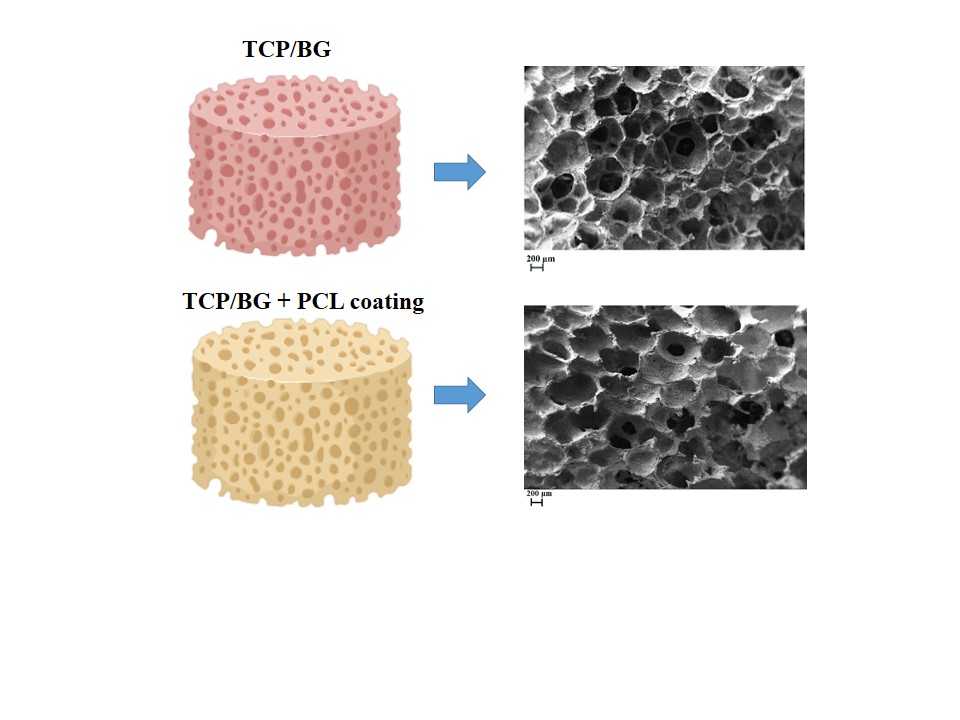
Bio-ceramics are a set of ceramic materials which possess an important feature called biocompatibility. Bioglass is one of the most applicable ceramic materials which results in bioactivity improvement due to the presence of Si as an ossification material. Besides, PCL polymer supported by bioglass nanoparticles was used to improve the mechanical properties. In this study, we combined TCP (Tricalciumphosphate) with NBG (nano-bioglass) with 4 different amounts (10%, 20%, 30% and 0%) to produce composite scaffolds (lost sponge foam method); then, we coated these composites by PCL (Polycaprolactone) biopolymer, and eventually, we evaluated its bioactivity, biodegradability and mechanical properties. SEM and EDS methods were used to study the morphology and bioactivity of scaffolds. The results of ion concentration measurement test and SEM and EDS analysis show the formation of Apatite on scaffold’s surface. The results from SEM indicate that most bioactivity was observed for composite scaffold containing 20%wt of nano-bioglass. Generally, the composite scaffold containing 20%wt of bioglass was presented as the most preferable sample, in terms of mechanical properties and bioactivity.
References
S. Rahimi, F. SharifianJazi, A. Esmaeilkhanian, M. Moradi, A.H. Safi Samghabadi, Effect of SiO2 content on Y-TZP/Al2O3 ceramic-nanocomposite properties as potential dental applications, Ceramics International 46(8, Part A) (2020) 10910-10916.
E. Jabbarzadeh, T. Starnes, Y.M. Khan, T. Jiang, A.J. Wirtel, M. Deng, Q. Lv, L.S. Nair, S.B. Doty, C.T. Laurencin, Induction of angiogenesis in tissue-engi-neered scaffolds designed for bone repair: a combined gene therapy–cell trans-plantation approach, Proceedings of the National Academy of Sciences 105(32) (2008) 11099-11104.
A. Moghanian, A. Ghorbanoghli, M. Kazem-Rostami, A. Pazhouheshgar, E. Salari, M. Saghafi Yazdi, T. Alimardani, H. Jahani, F. Sharifian Jazi, M. Tahriri, Novel antibacterial Cu/Mg-substituted 58S-bioglass: Synthesis, characterization and investigation of in vitro bioactivity, International Journal of Applied Glass Science 11(4) (2020) 685-698.
L. Bazli, H. Nargesi khoramabadi, A. Modarresi Chahardehi, H. Arsad, B. Malekpouri, M. Asgari Jazi, N. Azizabadi, Factors influencing the failure of dental implants: a systematic review, Journal of Composites and Compounds 2(2) (2020) 18-25.
F. Sharifianjazi, N. Parvin, M. Tahriri, Formation of apatite nano-needles on novel gel derived SiO2-P2O5-CaO-SrO-Ag2O bioactive glasses, Ceramics Inter-national 43(17) (2017) 15214-15220.
C. Gao, Y. Deng, P. Feng, Z. Mao, P. Li, B. Yang, J. Deng, Y. Cao, C. Shuai, S. Peng, Current progress in bioactive ceramic scaffolds for bone repair and regener-ation, International journal of molecular sciences 15(3) (2014) 4714-4732.
U. Kneser, D.J. Schaefer, E. Polykandriotis, R.E. Horch, Tissue engineering of bone: the reconstructive surgeon’s point of view, Journal of cellular and molecular medicine 10(1) (2006) 7-19.
L. Lu, Q. Zhang, D. Wootton, R. Chiou, D. Li, B. Lu, P. Lelkes, J. Zhou, Bio-compatibility and biodegradation studies of PCL/?-TCP bone tissue scaffold fab-ricated by structural porogen method, Journal of Materials Science: Materials in Medicine 23(9) (2012) 2217-2226.
M.S.N. Shahrbabak, F. Sharifianjazi, D. Rahban, A. Salimi, A Comparative Investigation on Bioactivity and Antibacterial Properties of Sol-Gel Derived 58S Bioactive Glass Substituted by Ag and Zn, Silicon 11(6) (2019) 2741-2751.
J.L. Drury, D.J. Mooney, Hydrogels for tissue engineering: scaffold design variables and applications, Biomaterials 24(24) (2003) 4337-4351.
C.-F. Wang, B. Hu, H.-H. Yi, W.-B. Li, The effect of PS porosity on the struc-ture, optical and electrical properties of ZnS/PS, Optics and Spectroscopy 116(3) (2014) 427-430.
F. Sharifianjazi, N. Parvin, M. Tahriri, Synthesis and characteristics of sol-gel bioactive SiO2-P2O5-CaO-Ag2O glasses, Journal of Non-Crystalline Solids 476 (2017) 108-113.
Z. Goudarzi, N. Parvin, F. Sharifianjazi, Formation of hydroxyapatite on sur-face of SiO2–P2O5–CaO–SrO–ZnO bioactive glass synthesized through sol-gel route, Ceramics International 45(15) (2019) 19323-19330.
A. Esmaeilkhanian, F. Sharifianjazi, A. Abouchenari, A. Rouhani, N. Parvin, M. Irani, Synthesis and characterization of natural nano-hydroxyapatite derived from turkey femur-bone waste, Applied biochemistry and biotechnology 189(3) (2019) 919-932.
B. Liu, D.x. Lun, Current application of ??tricalcium phosphate composites in orthopaedics, Orthopaedic surgery 4(3) (2012) 139-144.
S.H. Kwon, Y.K. Jun, S.H. Hong, I.S. Lee, H.E. Kim, Y.Y. Won, Calcium phosphate bioceramics with various porosities and dissolution rates, Journal of the American Ceramic Society 85(12) (2002) 3129-3131.
S. Bose, J. Darsell, M. Kintner, H. Hosick, A. Bandyopadhyay, Pore size and pore volume effects on alumina and TCP ceramic scaffolds, Materials Science and Engineering: C 23(4) (2003) 479-486.
C. Young, P. Ladd, C. Browning, A. Thompson, J. Bonomo, K. Shockley, C. Hart, Release, biological potency, and biochemical integrity of recombinant human platelet-derived growth factor-BB (rhPDGF-BB) combined with Aug-mentTM Bone Graft or GEM 21S beta-tricalcium phosphate (?-TCP), Journal of controlled release 140(3) (2009) 250-255.
L. Bazli, M. Siavashi, A. Shiravi, A review of carbon nanotube/TiO2 composite prepared via sol-gel method, Journal of Composites and Compounds 1(1) (2019) 1-9.
S. Saadi, B. Nazari, Recent developments and applications of nanocomposites in solar cells: a review, Journal of Composites and Compounds 1(1) (2019) 41-50.
L. Bazli, A. Khavandi, M.A. Boutorabi, M. Karrabi, Correlation between vis-coelastic behavior and morphology of nanocomposites based on SR/EPDM blends compatibilized by maleic anhydride, Polymer 113 (2017) 156-166.
L. Bazli, A. Khavandi, M.A. Boutorabi, M. Karrabi, Morphology and visco-elastic behavior of silicone rubber/EPDM/Cloisite 15A nanocomposites based on Maxwell model, Iranian Polymer Journal 25(11) (2016) 907-918.
D. Rohner, D.W. Hutmacher, T.K. Cheng, M. Oberholzer, B. Hammer, In vivo efficacy of bone?marrow?coated polycaprolactone scaffolds for the reconstruction of orbital defects in the pig, Journal of Biomedical Materials Research Part B: Applied Biomaterials: An Official Journal of The Society for Biomaterials, The Japanese Society for Biomaterials, and The Australian Society for Biomaterials and the Korean Society for Biomaterials 66(2) (2003) 574-580.
M.C. Phipps, W.C. Clem, J.M. Grunda, G.A. Clines, S.L. Bellis, Increasing the pore sizes of bone-mimetic electrospun scaffolds comprised of polycaprolac-tone, collagen I and hydroxyapatite to enhance cell infiltration, Biomaterials 33(2) (2012) 524-534.
S.I. Yoon, Y.K. Lee, K.N. Kim, S. Kim, H. Son, J. Kwak, J. Kim, H. Choi, A comparison of the bone-like apatite formation potency between Hydroxyapatite and ?-Tricalcium phosphate in Glass ionomer dental luting cement, Key Engineer-ing Materials, Trans Tech Publ, 2006, pp. 885-890.
A. Ibara, H. Miyaji, B. Fugetsu, E. Nishida, H. Takita, S. Tanaka, T. Sugaya, M. Kawanami, Osteoconductivity and biodegradability of collagen scaffold coated with nano-?-TCP and fibroblast growth factor 2, Journal of Nanomaterials 43 (2013).
M. Ngiam, S. Liao, A.J. Patil, Z. Cheng, C.K. Chan, S. Ramakrishna, The fabrication of nano-hydroxyapatite on PLGA and PLGA/collagen nanofibrous composite scaffolds and their effects in osteoblastic behavior for bone tissue engi-neering, Bone 45(1) (2009) 4-16.
Y. Yang, Y. Zhao, G. Tang, H. Li, X. Yuan, Y. Fan, In vitro degradation of po-rous poly (l-lactide-co-glycolide)/?-tricalcium phosphate (PLGA/?-TCP) scaffolds under dynamic and static conditions, Polymer Degradation and Stability 93(10) (2008) 1838-1845.
W. Xue, A. Bandyopadhyay, S. Bose, Polycaprolactone coated porous trical-cium phosphate scaffolds for controlled release of protein for tissue engineering, Journal of Biomedical Materials Research Part B: Applied Biomaterials: An Of-ficial Journal of The Society for Biomaterials, The Japanese Society for Bioma-terials, and The Australian Society for Biomaterials and the Korean Society for Biomaterials 91(2) (2009) 831-838.
X. Zhang, W. Chang, P. Lee, Y. Wang, M. Yang, J. Li, S.G. Kumbar, X. Yu, Polymer-ceramic spiral structured scaffolds for bone tissue engineering: effect of hydroxyapatite composition on human fetal osteoblasts, PloS one 9(1) (2014).
Article DOR: 20.1001.1.26765837.2020.2.2.6.4
Published
How to Cite
Issue
Section
License
Copyright (c) 2020 JCC Research Group

This work is licensed under a Creative Commons Attribution 4.0 International License.