A theoretical Investigation on mechanical behavior of PEEK/MWCNT/bioactive glass composites for dental and bone implant applications
DOI:
https://doi.org/10.66224/jcc.8.1.7Abstract
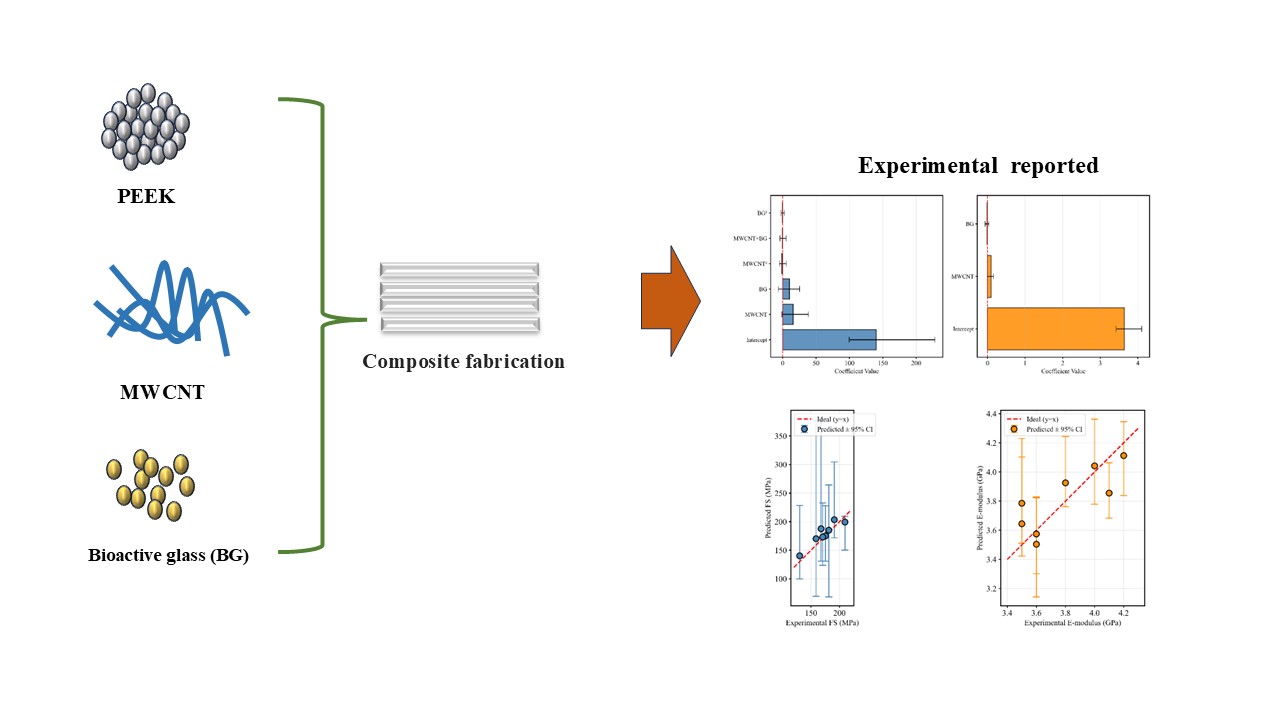
Due to having an elastic modulus similar to that of bone, polyetheretherketone (PEEK) is a good choice for personalized bone and dental implants; however, its non-bioactive nature hinders its usage. The present study establishes innovative predictive models that optimize the flexural strength and elastic modulus of PEEK composites with multi-walled carbon nanotubes (MWCNT) and bioactive glass (BG). Eight different composite types containing 0 to 5 wt% of MWCNTs and 0 to 10 wt% of BG were made and then assessed. To quantify model uncertainty, response surface methodology (RSM) combined with Bootstrap re-sampling (2000 iterations) was applied. The full quadratic model predicts flexural strength accurately (R² = 0.9851) and indicates that the ideal composition is 3 wt% MWCNT and 5 wt% BG with a flexural strength of 209.47 MPa, which is a 60.9% increase compared to pure PEEK. Negative quadratic and interaction coefficients confirmed the influence of agglomeration processes of fillers and stress concentration at higher levels of material concentration. In terms of elastic modulus, reduced linear model (R² = 0.6460) confirmed an important effect of the reinforcement material, i.e., MWCNT on the enhancement of elastic modulus while no particular effect of BG was confirmed.
Downloads
Published
How to Cite
Issue
Section
License
Copyright (c) 2026 .

This work is licensed under a Creative Commons Attribution 4.0 International License.