Predictive Modeling of Porosity and Mechanical Performance in Alumina–Zirconia–Hydroxyapatite Composites via Interpretable Random Forest Regression
DOI:
https://doi.org/10.66224/jcc.8.1.6Abstract
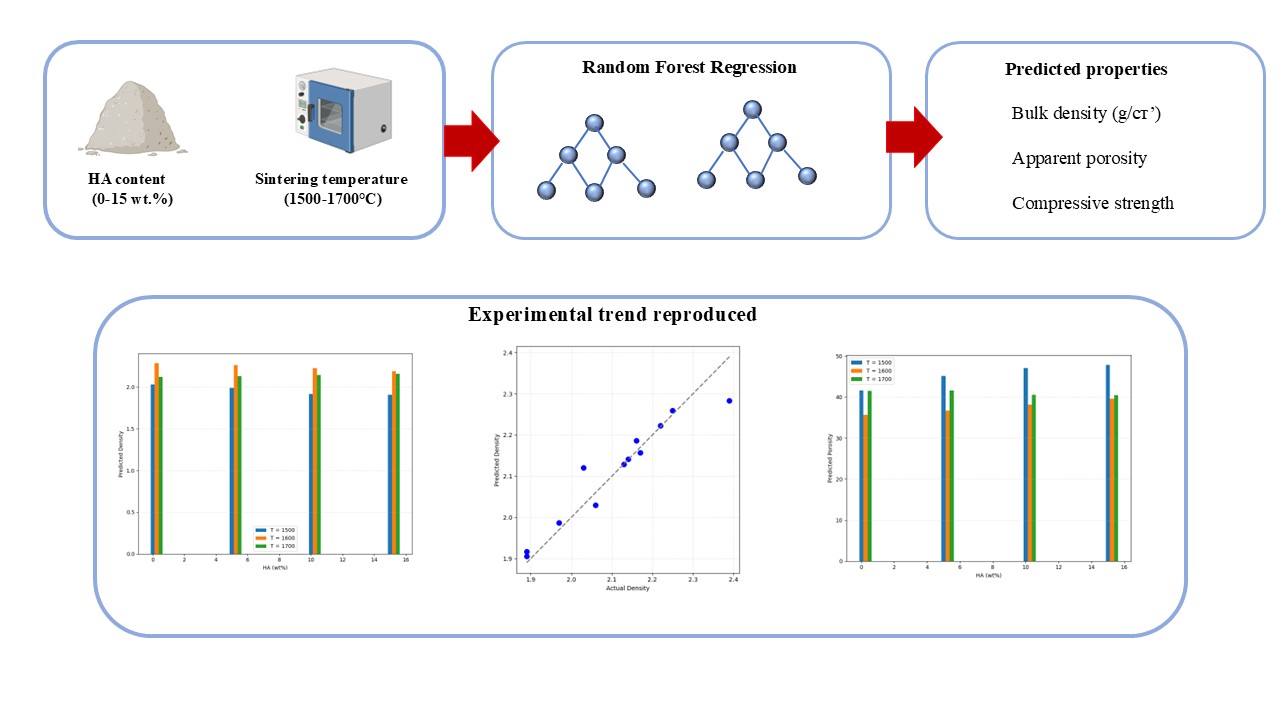
The development of bioactive ceramic composites with tailored physical and mechanical properties requires accurate prediction tools capable of capturing complex, nonlinear processing–structure–property relationships. In this work, an interpretable machine learning approach based on Random Forest regression is employed to predict bulk density, apparent porosity, and compressive strength in sol-gel-derived Al2O3–ZrO2–hydroxyapatite (HA) composites using only HA content (0–15 wt.%) and sintering temperature (1500–1700 °C) as inputs. Trained on a dataset of 12 experimental observations from the original study (JCC11), the model achieves excellent predictive performance, with coefficients of determination (R²) of 0.97–0.98 across all target properties and low error metrics (MAE < 1.3 MPa for strength; < 0.04 g/cm³ for density). The model successfully reproduces key experimental trends, including the peak in compressive strength at 1600 °C and the counterintuitive densification at 1700 °C due to liquid-phase formation. Feature importance analysis reveals that sintering temperature dominates mechanical response (65% contribution to compressive strength prediction), while both temperature and HA content jointly govern porosity and density (~55% vs. 45%). This data-driven framework demonstrates that interpretable machine learning can effectively model complex ceramic systems with limited data, offering a powerful tool for rational design and inverse optimization of next-generation bioactive composites.
Downloads
Published
How to Cite
Issue
Section
License
Copyright (c) 2026 .

This work is licensed under a Creative Commons Attribution 4.0 International License.