Gelatin-Based Biocomposites for Skin Regeneration and Wound Repair
DOI:
https://doi.org/10.66224/jcc.8.1.4Abstract
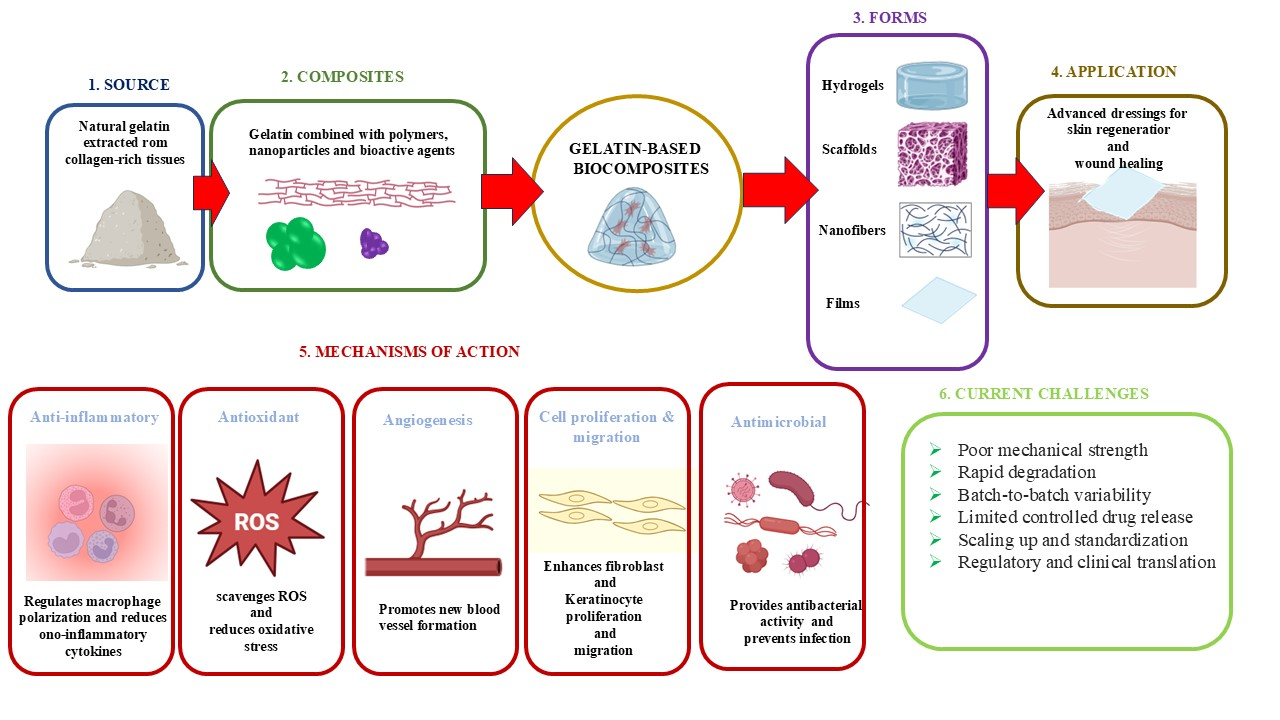
Chronic skin injuries constitute a serious medical problem, since they suffer from prolonged inflammatory response, angiogenesis impairment, bacterial infection, and delayed regeneration of tissues. Traditional skin dressings usually offer only passive protection, and cannot regulate the local microenvironment actively. For that reason, biomaterial approaches can serve as efficient methods of skin regeneration. Among the natural biomaterials, gelatin attracts much attention due to good biocompatibility, biodegradability, the ability to mimic the ECM, and the ease of manufacturing into various forms, such as hydrogels, scaffolds, nanofibers, and bioinks. However, the low mechanical stability, fast degradation rate, and weak antibacterial effect of gelatin do not allow using this substance directly in medicine. That is why modern research concentrates on gelatin biocomposites, which consist of gelatin and various natural or artificial polymers, inorganic nanoparticles, and bioactive components. This article gives an overview of the structural features and biological properties of gelatin, describes recent advances in the use of gelatin biocomposites for skin regeneration and wound healing, and explains their modes of action, namely inflammation modulation, angiogenesis stimulation, cell proliferation and migration, ECM remodeling, and antimicrobial effects. Furthermore, current challenges related to large-scale production, standardization, controlled drug delivery, and clinical translation are discussed, together with emerging strategies involving smart hydrogels, multifunctional nanocomposites, and 3D bioprinting technologies.
Published
How to Cite
Issue
Section
License
Copyright (c) 2026 .

This work is licensed under a Creative Commons Attribution 4.0 International License.