Evaluating the Impact of Calcium Hydroxide on the Push-out Bond Strength of Resin-based Endodontic Sealers: An in Vitro Study
DOI:
https://doi.org/10.66224/jcc.8.1.2Abstract
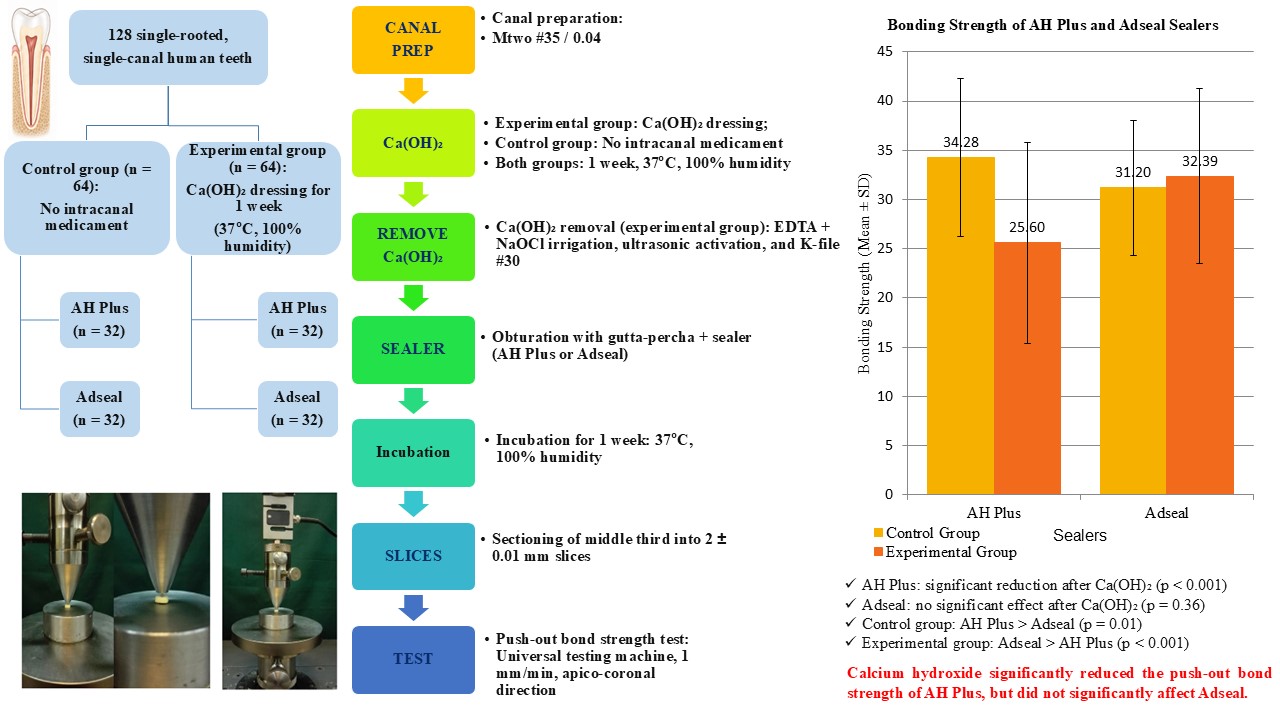
Conventional endodontic treatment aims to preserve teeth that would otherwise require extraction through cleaning, shaping, and obturation of the root canal system. Successful treatment depends on accurate diagnosis, effective debridement and disinfection, and complete canal filling to promote tissue repair. Resin-based sealers, particularly epoxy resin sealers, are widely used because of their favorable properties. This in vitro study compared the effect of calcium hydroxide (Ca(OH)2) on the push-out bond strength of AH Plus and Adseal sealers. A total of 128 single-rooted human teeth were allocated to control (without Ca(OH)2) and experimental (with Ca(OH)2) groups. After one week, Ca(OH)2 was removed and canals were obturated with AH Plus or Adseal. Following a further week of incubation, specimens were sectioned and subjected to push-out testing. AH Plus showed significantly lower bond strength after Ca(OH)2 medication compared with the control group (p<0.001), whereas Adseal was not significantly affected (p=0.36). In the control group, AH Plus exhibited higher bond strength than Adseal (p=0.01); however, in the experimental group, Adseal demonstrated significantly higher bond strength than AH Plus (p<0.001). Within the limitations of this study, Ca(OH)2 adversely affected AH Plus but not Adseal. Further clinical studies are needed to confirm these findings.
Published
How to Cite
Issue
Section
License
Copyright (c) 2026 .

This work is licensed under a Creative Commons Attribution 4.0 International License.