Predictive modeling of compressive strength and Young’s Modulus in MWCNT/45S5 bioglass scaffolds for bone tissue engineering
DOI:
https://doi.org/10.66224/jcc.7.4.7Abstract
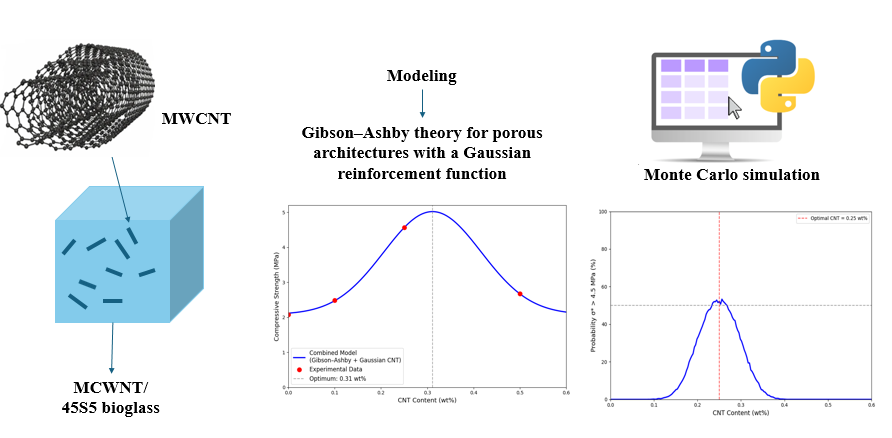
The clinical application of 45S5 bioglass® in load-bearing bone regeneration is limited by its inherently low mechanical strength. While the incorporation of multi-walled carbon nanotubes (MWCNTs) has shown promise in enhancing the mechanical properties of bioglass scaffolds, the resulting non-monotonic response, characterized by an initial increase followed by a decline at higher CNT loadings, poses a significant challenge for predictive modeling. In this study, we present a physics-informed, data-driven framework to accurately predict both the compressive strength and Young’s modulus of freeze-cast MWCNT/45S5 bioglass composite scaffolds. Our model integrates the Gibson–Ashby theory for porous architectures with a Gaussian reinforcement function that captures the optimal CNT loading and the detrimental effects of agglomeration. Calibrated against experimental data from Touri et al. (2013), the model achieves excellent agreement, predicting peak compressive strength (5.02 MPa) and Young’s modulus (305.8 MPa) at CNT contents of 0.311 wt.% and 0.319 wt.%, respectively. Furthermore, Monte Carlo simulations were employed to quantify the probabilistic reliability of achieving target mechanical thresholds (>4.5 MPa for strength, >250 MPa for modulus). These analyses reveal a robust processing window (0.25–0.40 wt.% CNT) where mechanical performance is highly reliable, providing critical guidance for scaffold design.
Published
How to Cite
Issue
Section
License
Copyright (c) 2025 .

This work is licensed under a Creative Commons Attribution 4.0 International License.