Predicting cognitive decline in Alzheimer’s disease using minimal clinical features: A machine learning approach with the NACC cohort
DOI:
https://doi.org/10.66224/jcc.6.2.7Abstract
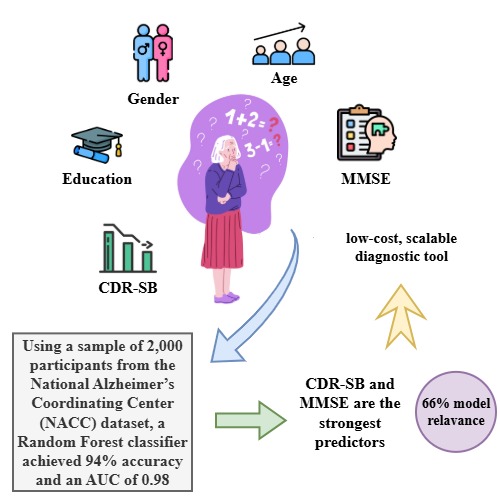
Early identification of individuals at risk for Alzheimer’s disease–related cognitive decline is crucial for timely intervention and clinical trial enrollment. We developed a machine learning model using only five routinely collected clinical variables, age, sex, education, baseline Mini-Mental State Examination (MMSE), and Clinical Dementia Rating–Sum of Boxes (CDR-SB), to predict cognitive decline three years in advance. Using a sample of 2,000 participants from the National Alzheimer’s Coordinating Center (NACC) dataset, a Random Forest classifier achieved 94% accuracy and an AUC of 0.98 on an independent test set. Feature importance analysis confirmed that CDR-SB and MMSE were the strongest predictors, collectively accounting for 66% of model relevance. This approach offers a low-cost, scalable tool for risk stratification, particularly valuable in low-resource settings and primary care, where advanced diagnostics are unavailable.
Published
How to Cite
Issue
Section
License
Copyright (c) 2024 .

This work is licensed under a Creative Commons Attribution 4.0 International License.