A physics-informed core–shell mori–tanaka model for predicting the mechanical reinforcement of chitosan/PVA hydrogels functionalized with aloe vera and green-synthesized ZnO nanoparticles
DOI:
https://doi.org/10.66224/jcc.5.4.7Abstract
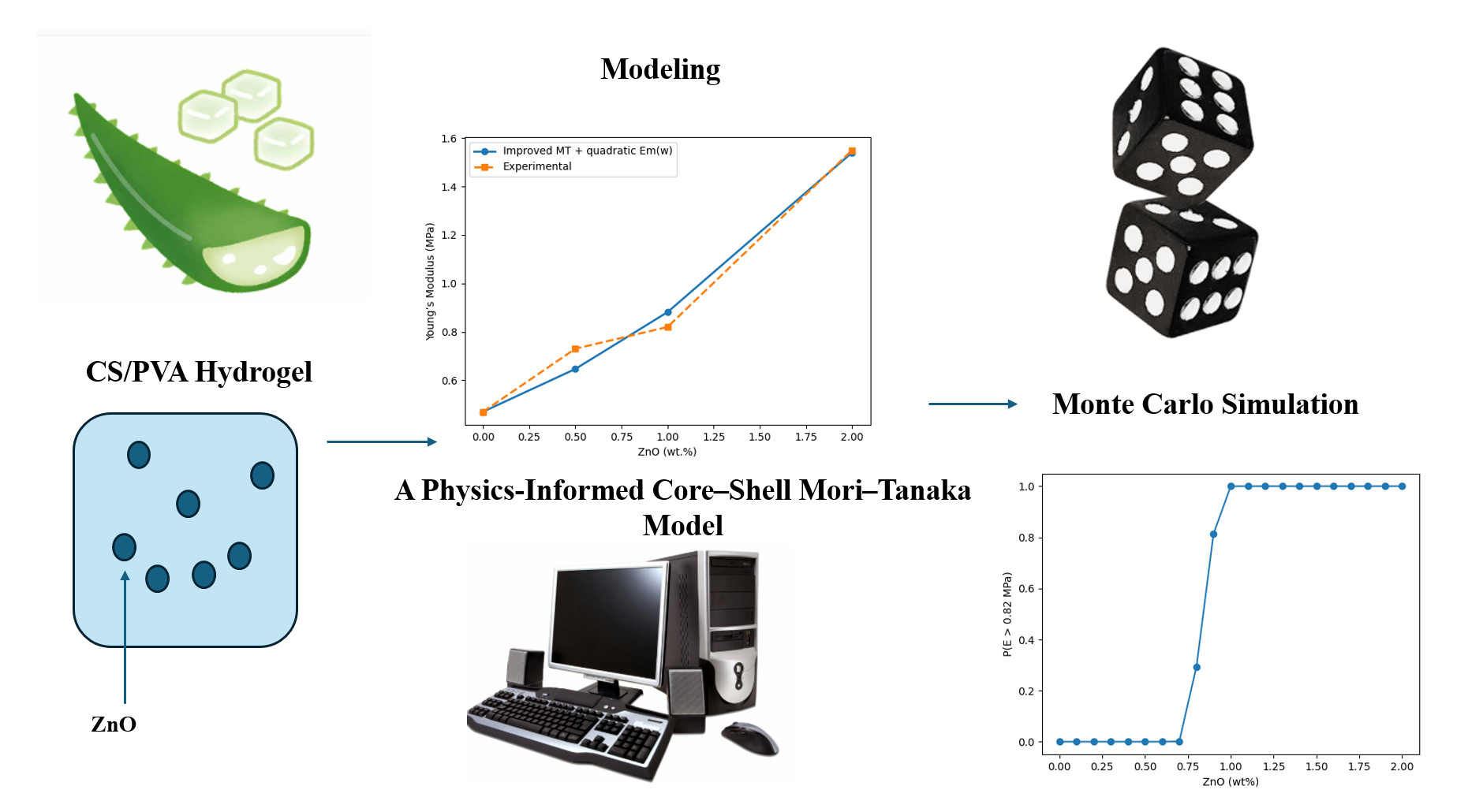
Chitosan/poly(vinyl alcohol) (CS/PVA) hydrogels functionalized with Aloe vera (AV) and green-synthesized ZnO nanoparticles (ZnO-NPs) show promise as multifunctional wound dressings. While experiments reveal a nonlinear increase in Young’s modulus with ZnO loading, the underlying reinforcement mechanism remains unclear. We propose a physics-informed, three-phase core–shell Mori–Tanaka model that accounts for AV-induced matrix softening, Zn2+-mediated ionic cross-linking, and a load-transferring interphase around ZnO-NPs. Calibrated against experimental data (0–2 wt.% ZnO), the model predicts Young’s modulus with high accuracy (e.g., 1.54 MPa predicted vs. 1.55 MPa measured at 2 wt.%). Monte Carlo analysis shows mechanical performance is governed primarily by the effective matrix and interphase moduli, not the intrinsic stiffness of ZnO, highlighting interfacial chemistry as the key design lever. This work provides a predictive framework for rational design of mechanically tunable hydrogels for wound healing.
Published
How to Cite
Issue
Section
License
Copyright (c) 2023 .

This work is licensed under a Creative Commons Attribution 4.0 International License.