Investigation of the biphasic effect of lithium ions on HUVEC proliferation in bioactive glass extracts for burn wound regeneration
DOI:
https://doi.org/10.66224/jcc.7.3.6Abstract
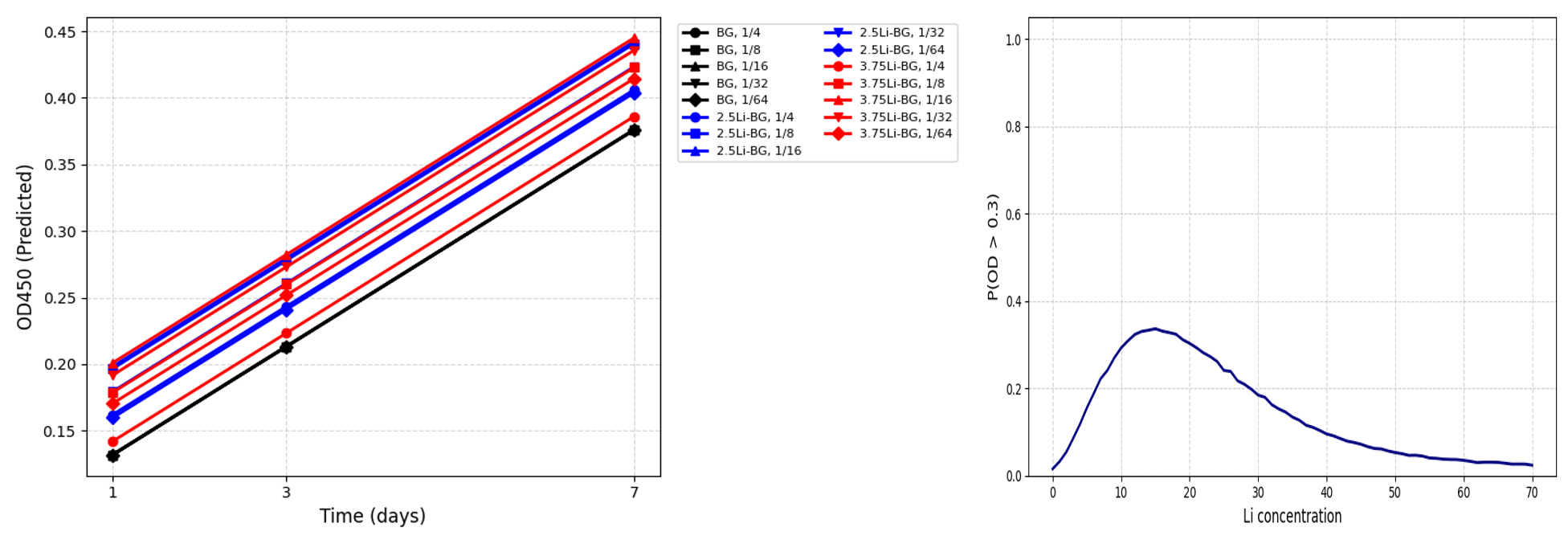
In the current work, we developed a simplified empirical formula to isolate and define the effect of lithium ions (Li+) released from Li-BG on the proliferation of human umbilical vein endothelial cells (HUVECs), based on experiments by Wei et al. We incorporate both culture time and concentration of Li+ (0–65.4 ppm), while providing a hormesis term to partition the characteristic biphasic (bell-shaped) cellular response to lithium. Nonlinear regression to discover best-fit parameters resulted in R2 = 0.8707 and RMSE = 0.0404. Models predict maximum stimulatory effects would occur at ~15 ppm Li+, which corresponds with our in vitro results that enhanced HUVEC viability occurred at 1/8–1/16 dilutions of 2.5Li-BG and 3.75 Li-BG nanostructured glasses. Additionally, Monte Carlo simulation determined, for the probability of desired cellular outcomes (>80% probability HUVEC OD450 > 0.3), there exists a therapeutic window (10–15 ppm) with maximum likelihood of achieving desired cellular consequences for probabilistic models. Although the full bioactivity of Li-BG is derived from the combined expression of Li+ and Si4+ ions, as demonstrated in the original experimentation, this framework focused exclusively on Li+ allows some predictive modeling to optimize subsequent ion release profiles for next-generation wound dressings.
Published
How to Cite
Issue
Section
License
Copyright (c) 2025 .

This work is licensed under a Creative Commons Attribution 4.0 International License.