Magnesium-doped 58S bioglass: synthesis, characterization, and biomedical applications
DOI:
https://doi.org/10.66224/jcc.7.1.9Abstract
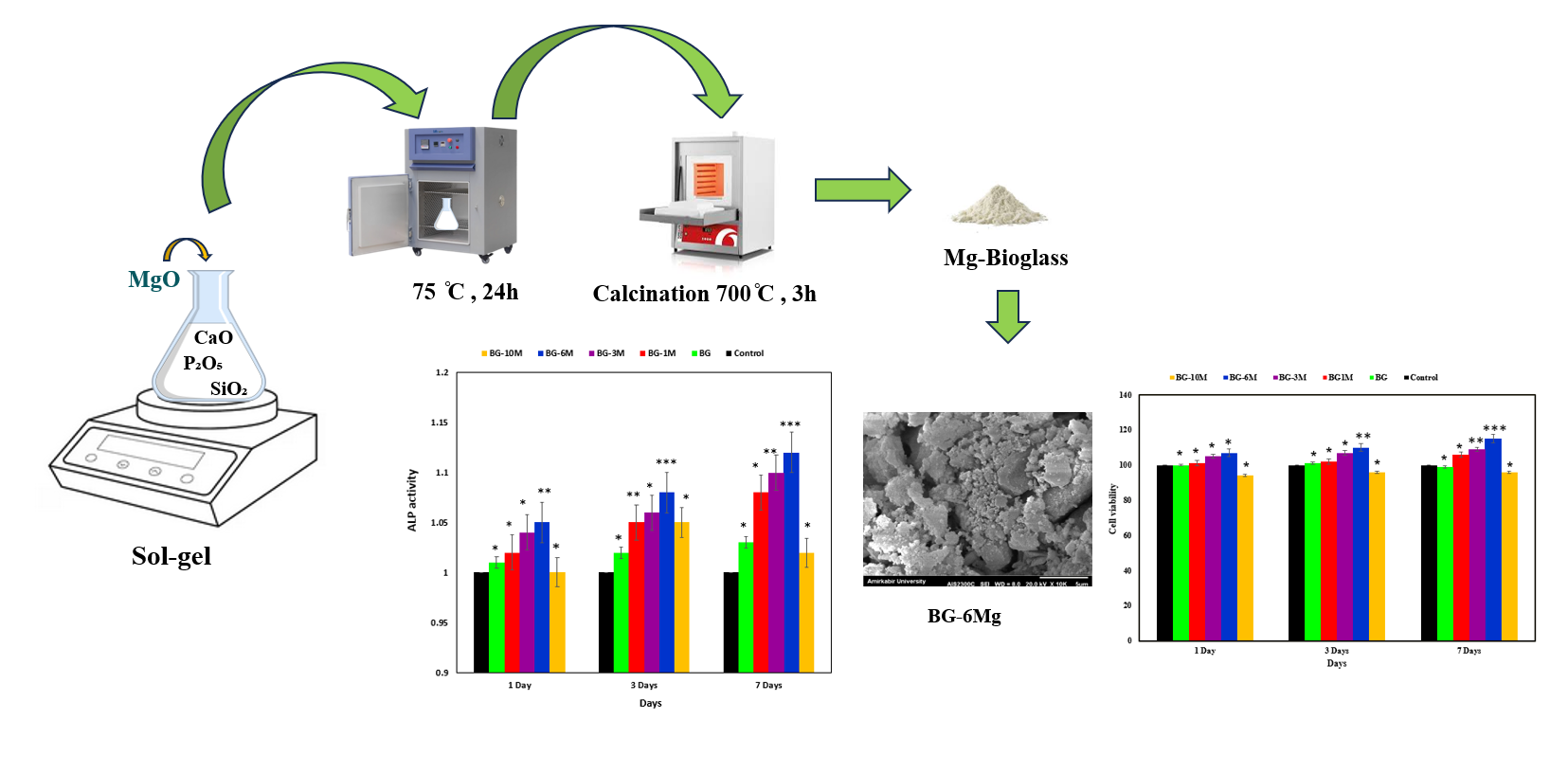
In the current study, bioactive glasses (BGs) in SiO2, CaO, P2O5, X MgO systems (x = 1, 3, 6 ,10 mol%) were synthesized through the sol-gel method and immersed in simulated body fluid (SBF) for a few days to investigate their biocompatibility. The impact of magnesium concentrations on cell viability, antibacterial properties, and the in vitro production of hydroxyapatite (HA) was investigated. Scanning electron microscopy (SEM) was utilized to examine the HA formation and its microstructure. The techniques of the 3-(4,5-dimethylthiazol-2-yl)-2,5-diphenyltetrazolium bromide (MTT) assay and alkaline phosphatase (ALP) were used to assess cell differentiation and proliferation MC3T3-E1 osteoblast cells. The highest rate of HA formation occurred in magnesium-doped 58S bioglass BG containing 6 mol% MgO. However, bioactivity decreased when the substitution reached 10 mol%. MTT assay and ALP data indicated that the proliferation and differentiation of MC3T3-E1 osteoblast cells improved with MgO substitution up to 6 mol%. In contrast, the 10 mol% substitution negatively affected cell proliferation and differentiation. Therefore, the results revealed that the Mg-doped 58S BG demonstrates significant bioactivity, antibacterial properties, and strong cell survival, making it a suitable choice for bone tissue and dental applications.
Published
How to Cite
Issue
Section
License
Copyright (c) 2025 .

This work is licensed under a Creative Commons Attribution 4.0 International License.