Takayanagi model and monte carlo simulation for predicting the Young’s modulus of PVC/AgNP nanocomposites: towards self-disinfecting materials to reduce SARS-CoV-2 transmission in healthcare settings
DOI:
https://doi.org/10.66224/jcc.6.1.5Abstract
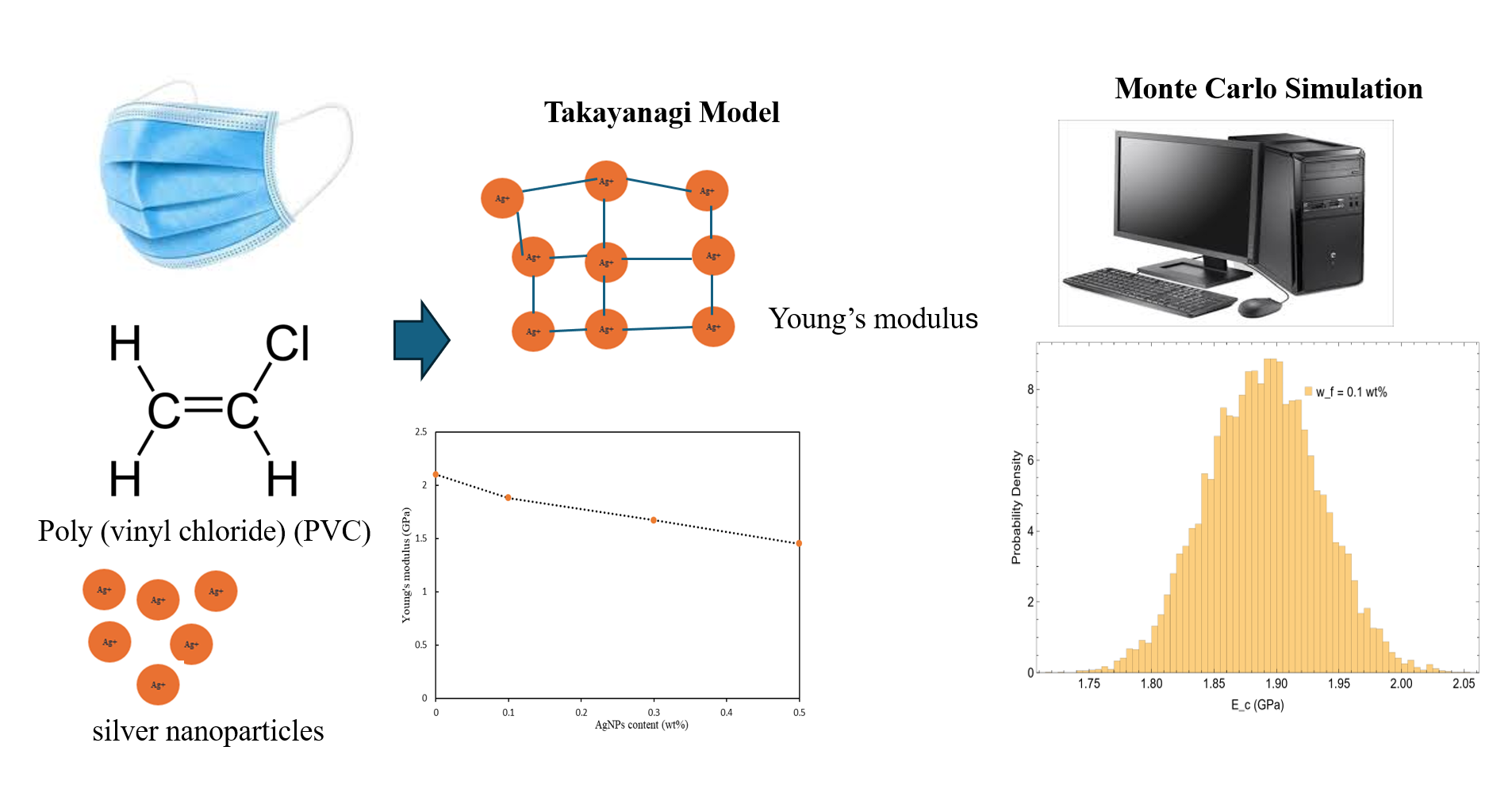
Poly (vinyl chloride) (PVC) is widely utilized in medical tools and structure applications owing to its biocompatibility, stability, and cost-efficiency. Nevertheless, conventional PVC is susceptible to microbial attachment, indicating the need for a self-disinfecting material. The present study analyzed PVC nanocomposites bio-filled with 0–0.5 wt% silver nanoparticles (AgNPs) to investigate their mechanical behavior using the Takayanagi model and Monte Carlo simulation approach. The Takayanagi model calculates the effective Young’s modulus based on a series-parallel arrangement of polymer matrices and the filler, while Monte Carlo simulation simulates uncertainties in the mechanical properties of PVC and AgNPs. Model predictions agreed with experimental data closely, with Young’s modulus decreasing as the nanoparticle content increased. Monte Carlo generated confidence intervals further confirming the efficacy of the approach. Evaluation outcomes indicate that the Takayanagi model in combination with stochastic simulations accurately predicts the mechanical properties of PVC/AgNP nanocomposites, which supports design of self-disinfection materials for healthcare applications in which both antimicrobial activity and mechanical performance is required.
Published
How to Cite
Issue
Section
License
Copyright (c) 2024 .

This work is licensed under a Creative Commons Attribution 4.0 International License.