Predictive drug release modeling of curcumin from Ag2O/SiO2-functionalized CS/PVA/SA hydrogels for enhanced wound healing
DOI:
https://doi.org/10.66224/jcc.7.3.5Abstract
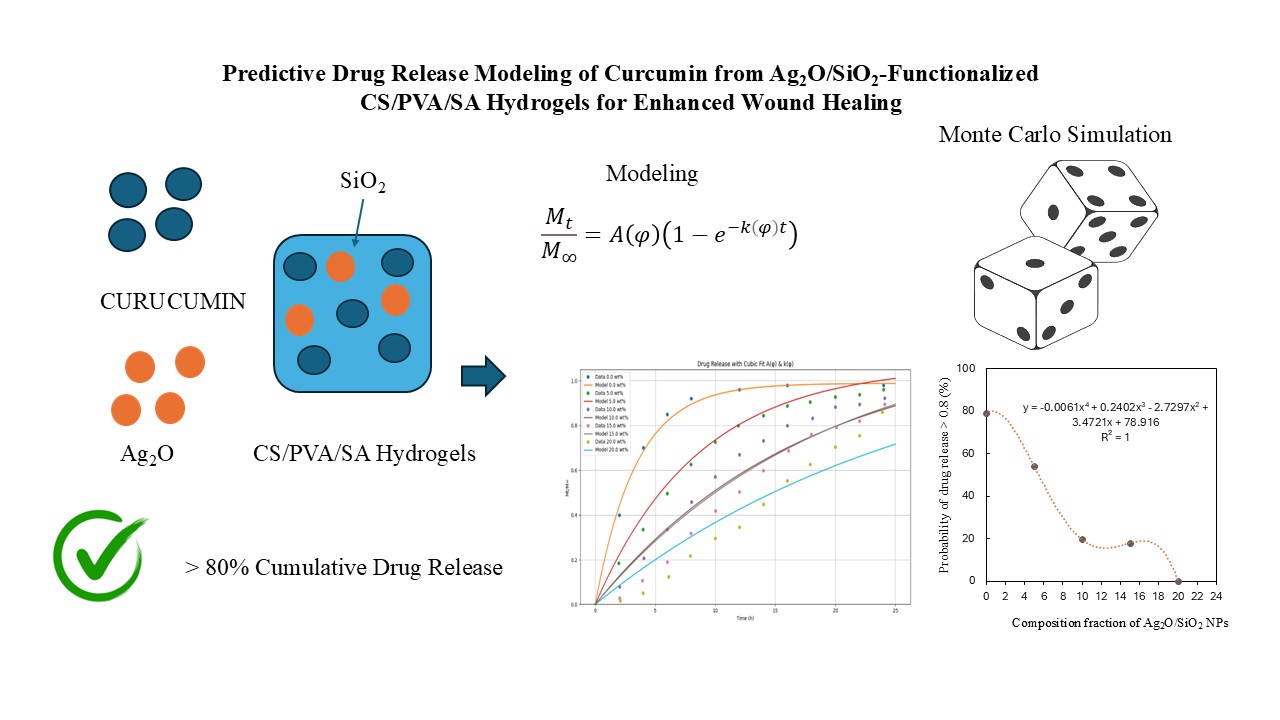
Chitosan/poly(vinyl alcohol)/sodium alginate (CS/PVA/SA) hydrogels have been established as a potential drug delivery vehicle for controlled drug release in wound healing applications when formulated with antimicrobial nanoparticles. In this research, we characterize the effect of particle loading (0–20 wt%) of mesoporous Ag2O/SiO2 nanoparticle addition on the curcumin drug release from CS/PVA/SA hydrogels. A first-order kinetic model was created to be able to predict drug release from CS/PVA/SA hydrogels with varying Ag2O/SiO2 NP composition fractions. The experimental results validated the model well (i.e., global RMSE = 0.0625), demonstrating that drug release is effectively slowed in a substantive manner depending on the nanoparticle loading added. Reliability of the system in the context of parametric uncertainty was evaluated through the use of Monte Carlo Simulations along with the kinetic model, where success probability was defined as the potential to achieve >80% cumulative drug release. Results demonstrated a significant time-dependent increase in the success probability (R2 = 0.9822) toward nearly complete certainty after 20 hours, while nanoparticle loading exhibited an inverse relationship on drug release efficiency (R2 = 1), with the best drug release efficiency occurring at loading below 10wt%. Results offer a way to predictively design nanocomposite hydrogels for personalized drug release applications.
Published
How to Cite
Issue
Section
License
Copyright (c) 2025 .

This work is licensed under a Creative Commons Attribution 4.0 International License.