2D Materials: catalysis applications, opportunities, and challenges
DOI:
https://doi.org/10.66224/jcc.6.4.7Abstract
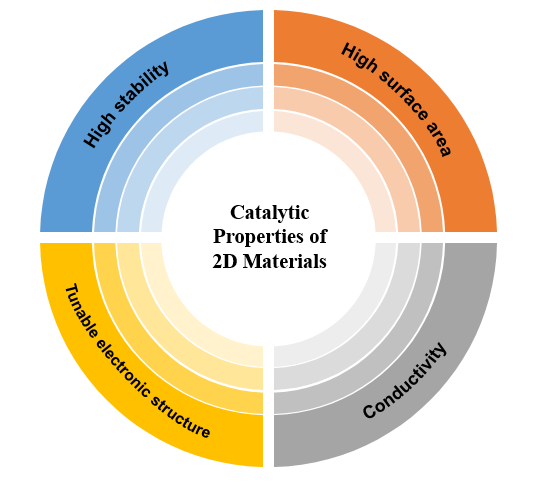
It has been discovered that two-dimensional (2D) materials possess tunable electronic properties and abundant active sites, making them ideal for catalysis. This comprehensive review examines the use of 2D materials as catalysts and catalyst supports in energy conversion and environmental remediation. This field is characterized by the ability to enhance catalytic activity and selectivity through the engineering of defects, heterostructures, and hybrid composites. Despite these advances, challenges remain in scaling up synthesis, achieving structural stability under reaction conditions, and translating laboratory discoveries into industrial applications. By developing advanced characterization techniques and understanding structure-activity relationships, we can fully exploit the potential of 2D materials for catalysis.
Published
How to Cite
Issue
Section
License
Copyright (c) 2024 .

This work is licensed under a Creative Commons Attribution 4.0 International License.